


A Portable Docking Aid System (PDAS) may be suitable when a berth requires vessel-approach information but a permanent installation is not suitable or is not yet required. GLEN positions PDAS as a portable berthing-aid solution for temporary berths, FSRU projects, commissioning, retrofit work and maintenance projects. It can be deployed without permanent jetty modifications and may also support operations during the repair, replacement or transition period of a fixed system.
GLEN PDAS uses dual lasers to monitor vessel distance and approach speed, with a monitoring range of up to 1,000 metres. A handheld HMI allows real-time berthing information to be viewed from different jetty locations. The system is available in a fully explosion-proof configuration for LNG, LPG and oil terminals.
Before deployment, hazardous-area requirements, communications, power supply and sensor-positioning requirements should be reviewed for each berth.

In many cases, yes. The first step is to confirm whether the existing hook structure and load path are suitable for a new load sensor or load-pin arrangement.
The retrofit design should address calibration, local display, alarm thresholds, data recording, cable routing and communication with the existing DCS or CMS. If the existing control system uses legacy protocols, a gateway or new local controller may be required. A successful retrofit can provide the owner with real-time mooring-load visibility without replacing the complete mechanical installation.
After the upgrade, MLMS can continuously monitor individual mooring-line loads and provide configurable load alarms, as well as local and remote load displays. The system can integrate with QRH and CMS. Through the CMS, mooring-load data can be connected to the DCS, supporting equipment-status monitoring, alarm management, historical data recording and trend analysis.
For existing terminals, GLEN also provides lifecycle services including inspection, calibration, performance testing, system integration and system upgrades.
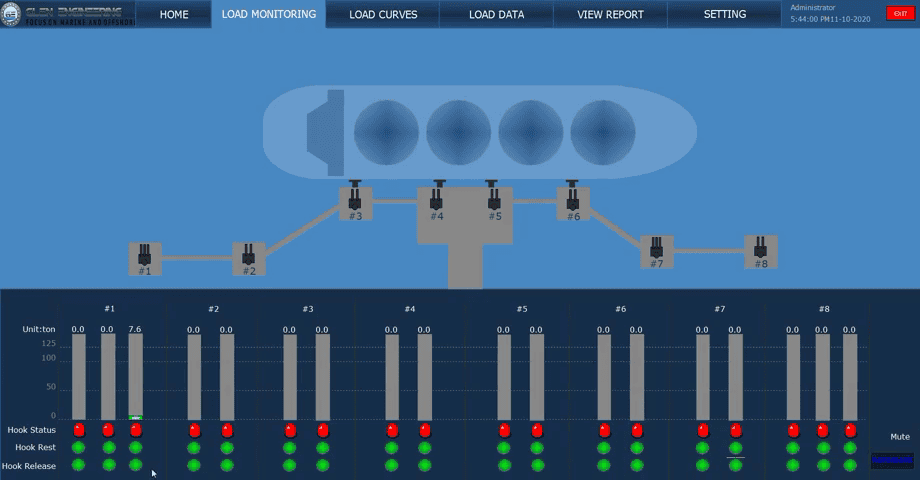
A complete Request for Quotation (RFQ) should define the required Safe Working Load (SWL), number of hooks, capstan requirements, vessel and mooring data, line angles, hazardous-area classification, remote release philosophy, reset requirements, load monitoring, PLC and control architecture, communication interfaces, foundation constraints, environmental conditions, certification requirements, proof-load and functional testing, documentation, spare parts, commissioning and Site Acceptance Test (SAT) expectations.
For LNG or FSRU projects, the RFQ should also identify Ship-Shore Link (SSL), Emergency Shutdown (ESD) and emergency mooring release interfaces.
Where the project requires remote release, load monitoring or centralized monitoring in addition to QRH, the RFQ should also define the relevant interface and control requirements. These may include communication methods, alarm requirements and data-integration scope for CMS, MLMS and EMS. During FEED, GLEN can support equipment selection and design, 3D installation-fit verification and static mooring analysis. Its QRH are available in single-hook and multi-hook configurations and can be combined with a remote release control system.
Defining these requirements at the RFQ stage helps suppliers respond to a consistent technical scope and supports subsequent system integration and testing.
 Marketing Team
 +86 23 86888095 ex 808

 26-4, Building 3, No.139 Songpai Road, Yubei District, Chongqing 401120 China